





Scare The Children – Interview with Sadako (English)
Death Metal, Groove Metal, Thrash Metal
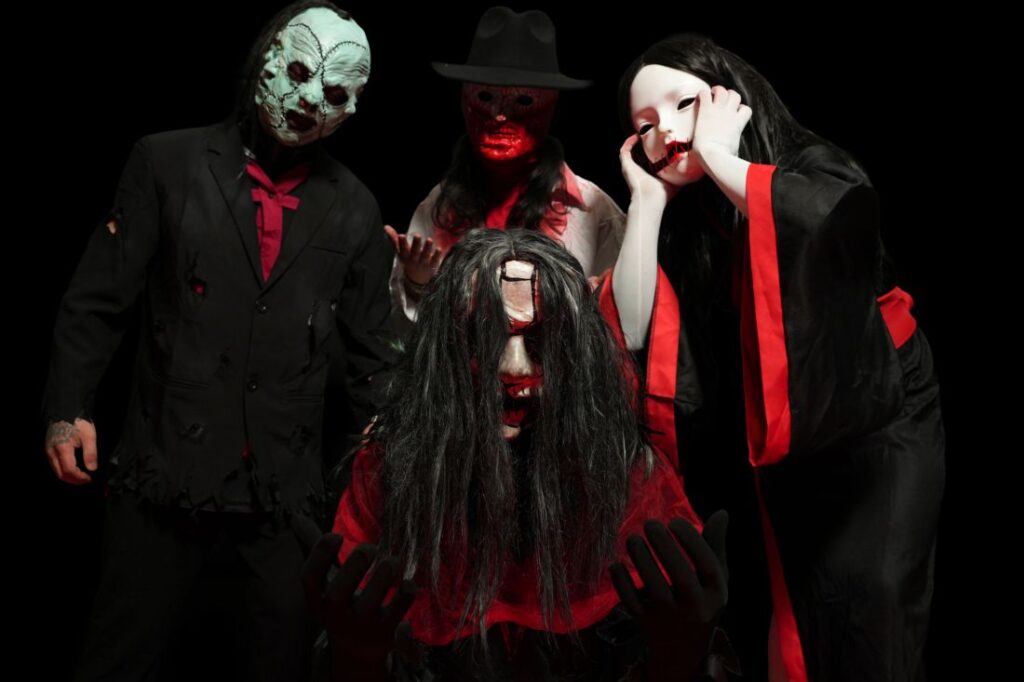
Bogeyman with depth
Anyone who reflexively lumps Scare The Children into the „theatrical metal with masks“ Slipknot category is definitely selling them short. Founded around twelve years ago deep in the Beijing underground, this international four-piece has worked its way up over the years to become a fascinating mainstay of the Chinese metal scene.
The band presents itself as a brilliant paradox: although geographically based in the Middle Kingdom, the current line-up unites international musicians with local talents from a wide variety of regions across China. It is precisely from this global melting pot of different cultures and generations that the troupe draws the visionary power for ist dark artwork.
In doing so, the sinister outfit doesn’t rely on cheap carnival hocus-pocus, but on a profound concept that takes a surprisingly personal, almost therapeutic turn on their current EP Forsaken: here, the true horror doesn’t lurk under the bed, but in the depths of one’s own psyche.
The fact that the band is making it to Europe and Switzerland for the very first time this summer for exclusive shows (such as on September 11, 2026, at the Sunset Bar in Martigny) and a performance at Rock The Lakes is nothing short of a minor metal miracle, given the enormous logistical and financial effort involved.
A few weeks before the start of their adventure, I had the opportunity to chat with founding member and vocalist Psy Sadako. The result is an open and deep conversation about the challenges of putting on an explicit horror show within the constraints of strict censorship laws, the emergence of an involuntarily cute, viral fan cult online, and the question of how to rescue a dark club atmosphere under the glaring sun of a Swiss open-air festival.
Turn off your mind and step inside: Welcome to the other side!
Made in China
A horror metal band with international roots, founded in Beijing, arriving this summer to give Swiss stages a serious shaking—that sounds like one hell of a wild ride! For everyone just discovering the troupe, questions naturally arise about the identities behind the masks, their beginnings in far-off China over a decade ago, and the four-piece’s musical foundation.
Metalinside (Sandro): Who is hiding behind the masks, how did the band come to be founded in Beijing, and how would you describe your sound and your influences?
Psy Sadako: Scare The Children was born in Beijing around twelve years ago. Like many bands that survive for more than a decade, the lineup has changed several times along the way. The only original member remaining today is Sadako, one of the founder of the band, who continues to drive its creative vision.
Our current lineup consists of Sadako on vocals, Yuriko on keyboards and programming, Vlads on guitar, and Mört on drums. What makes Scare The Children unique is that we are a truly international band based in China. Not all of us are Chinese, and even the Chinese members originally come from different parts of the country. Beijing brought us together and became the home where this strange project could grow.
Musically, we describe ourselves as theatrical metal with strong horror influences. One of the strengths of the band is that we all come from different musical backgrounds and generations. Some members are influenced by modern metal, djent and contemporary heavy music, while others grew up with the classic metal bands that helped define the genre. Rather than following a single school of thought, we try to blend all of those influences into something that feels uniquely ours.
Of course, as soon as people see masks and heavy music, the comparison to Slipknot comes up. We take that as a compliment. They helped open doors for theatrical metal and showed how powerful a visual identity can be. But beyond the masks, we are focused on creating our own universe, one built around horror storytelling, atmosphere, and memorable live performances.
When Cuddle Slang Meets Pure Horror
Anyone searching for the band online will quickly come across a bit of a dual naming identity in Chinese cyberspace. While the official translated name is „Xià xiǎohái,“ the viral meme expression „Xià sǐ bǎobao“ has long since taken hold among the fanbase and on social media. It’s a tongue-in-cheek contrast that raises the question of how much room there is for internet slang in a horror metal band.
MI: How did this humorous nickname come about, and how well does this cute online slang fit with the actually dark identity of Scare The Children?
Psy Sadako: The funny thing is that we originally didn’t even have a Chinese name. Years ago, a Chinese promoter booked us for a show and simply decided to call us „吓小孩“ (Xià Xiǎohái), which literally means „Scare The Children.“ It was practical, but honestly, we never completely fell in love with it.
Around the same time, Chinese fans started calling us „吓死宝宝“ (Xià Sǐ Bǎobao) online. It’s a popular internet expression that roughly means „You scared me to death!“ but in a playful, self-deprecating way. We found it hilarious. It captured the spirit of the band much better than a direct translation because it was something the audience had created themselves.
We have never taken ourselves too seriously when it comes to things like this. Horror is supposed to be fun as well as frightening. When fans spontaneously gave us a nickname and it started spreading online, we embraced it. It felt natural rather than something imposed from above.
Today, most Chinese fans know us as „吓死宝宝“, and that’s perfectly fine with us. In a way, it belongs to them. We didn’t choose the name — they did — and that’s probably for the best.
Monsters in the Mind
With their debut Odyssey (2018), Scare The Children delivered a classic concept album about the cursed doll Betsy. Since then, a lot has happened in the horror metallers‘ camp: the anthology Tales, produced by Tue Madsen, is now followed by the EP Forsaken—a work that not only takes a new musical direction, but also pushed the band to their limits, both in terms of production and emotion. Behind the dense atmosphere this time lies a terrifyingly real horror.
MI: How has your storyline evolved from the debut to the new EP Forsaken, how did the entirely self-directed songwriting process go, and which song got particularly under your skin?
Psy Sadako: Our first album, Odyssey, was a complete horror story built around the cursed doll Betsy. Every song was connected, and together they formed a single narrative from beginning to end.
After that came Tales, which was mixed and produced by Tue Madsen. That record was inspired by old horror anthologies such as Tales from the Crypt. Instead of one continuous story, each song was its own self-contained nightmare, usually ending with a dark twist. Working with someone of Tue’s experience was an incredible opportunity for us and helped us take a major step forward as a band.
Forsaken is something very different. It is probably the most personal release we have ever created. It was also one of the most challenging because, this time, we decided to do everything ourselves. We handled the recording, production, and creative direction from start to finish. After having the chance to work with Tue Madsen on Tales, taking full responsibility for every aspect of the process was both intimidating and rewarding. It gave us complete freedom, but it also meant that every decision, every detail, and every mistake belonged to us.
The central question behind the EP is deceptively simple: What happens when you die? Is there silence? Judgement? Or is there something else waiting on the other side?
Of course, we are not necessarily talking about physical death. More often, Forsaken explores what happens when a part of you dies. The death of innocence, trust, hope, love, identity, or even the person you thought you were. The EP is rooted in themes of abandonment, trauma, recurring nightmares, depression, and the self-destructive behaviors that often follow.
For the concept, we imagined six emotions and psychological states and transformed them into monsters. In a strange way, you could describe it as a dark and twisted version of Inside Out. Each creature represents something that can consume a person from within. The listener is invited to cross over to „the other side“ and confront these entities one by one.
The phrase „Welcome to the Other Side“ became central to the record. On the surface, it asks what awaits us after death. But in reality, it is more about the moments when a part of ourselves dies and we are forced to become someone new. The monsters on Forsaken live in that space between who we were and who we become.
The horror is no longer hiding under the bed; it is already inside your head.
Interestingly, the songs themselves were not difficult to write. In many ways, writing them felt therapeutic. The challenging part was performing them. Some of the lyrics come from very real emotions and experiences, and when I sing them, I believe every word. Sometimes that can be emotionally exhausting, but at the same time it is incredibly liberating. There is something powerful about screaming those feelings out loud instead of carrying them alone.
One song that is particularly close to me is famiLIAR. It explores the eternal master-slave relationship built on false promises, manipulation, and dependence. Whether that relationship is between two people, a person and an addiction, or someone trapped in a destructive cycle is left open to interpretation. For me, it represents one of the central ideas of Forsaken: the monsters that keep us imprisoned often convince us that we need them.
More Than Just Masks
Anyone seeing Scare The Children live or in promo photos notices immediately: the custom-made, grotesque masks and outfits are no cheap carnival hocus-pocus, but are deeply rooted in the band’s concept. But how were these horror creatures originally brought to life, and do they actually possess a documented, psychological life of their own with their own backstory outside of the albums?
MI: How were your grotesque stage characters originally developed, and do fixed personalities with their own backstory hide behind the masks?
Psy Sadako: The characters on stage are not just costumes, and they are not fixed either. Over the years, they have evolved alongside the music, almost like living entities inside the Scare The Children universe.
Sadako originally existed as a widow who had already died, but through witchcraft she returns to life and becomes something between worlds — neither fully dead nor fully alive, more like a guide through the darker side of our stories.
Yuriko is tied to the idea of twins. She was always part of the band in some form, but within the concept, one of the sisters disappeared, and what remains is the darker reflection — the version that stayed behind when something went wrong.
Mört began as a ghoul-like creature and gradually evolved into something more unstable and unpredictable, almost a shapeshifter that can adapt depending on the story or emotion we are exploring in the music.
Vlads is the newest character and perhaps the most tragic in origin: a failed laboratory experiment, something created rather than born. That idea of artificial existence and identity is also reflected in parts of our newer material.
Each of these characters connects to specific songs and themes, but we prefer not to over-explain everything. They exist within the same universe, yet each listener can decide how deep they want to go into their individual backstories.
Growing Against the Grain
Over the years, Scare The Children have worked their way up to become a true mainstay of the Beijing underground. But what is life like for a theatrical horror outfit in a country known for its strict regulations? A look at the evolution of the local live landscape, the energy of the Chinese audience, and the creative way of navigating the strict hurdles of censorship.
MI: How have you experienced the evolution of the metal scene in Beijing over the years, and to what extent do local regulations or cultural circumstances influence the staging of your shows?
Psy Sadako: The metal scene in Beijing has evolved a lot over the years. When we started out, it was much smaller and more underground, but today there is a real community, with passionate fans and a lot of energy at shows. The audience here is really strong, and we feel a genuine connection when we play live.
We’ve never played in Europe yet, so it’s difficult for us to compare audiences directly. What we can say is that the support we receive locally has always been very powerful and motivating.
As for the limitations we sometimes face, we actually see them as part of what drives us forward. They never stopped us — if anything, they made us want to push harder. There were many moments where it would have been easier to give up, but we chose the opposite direction. We kept building, kept creating, and slowly it started to pay off.
Now, looking back, those challenges are part of the reason Scare The Children exists the way it does today.
The Mirror of Pain
The lyrics of Scare The Children dig through emotional debris, illuminating the deepest abysses of the human psyche. But where does theatrical fiction end, and where does real-world cruelty begin? A few thoughts on the nature of fear in everyday life and the question of whether giving shape to dark soundscapes can ultimately exert a cleansing, almost saving effect.
MI: What is the ultimate horror in real life for you personally, and does creating your music function as a kind of lifeline or therapy?
Psy Sadako: For me, the ultimate real-life horror is not something supernatural. It is the feeling of slowly losing yourself without even realizing it. Waking up one day and not recognizing the person you’ve become, or feeling disconnected from everything that used to give you meaning.
Abandonment plays a big role in that. Not just being left by others, but also the moments when you abandon parts of yourself just to keep going, to survive, or to cope with things you don’t fully understand at the time. Over time, that can create a version of you that feels distant from who you originally were.
Music has always been a way to confront that. It doesn’t fix anything, but it gives those feelings a form. When we play or write, we are not escaping those darker parts — we are putting them in front of us and forcing ourselves to face them directly. Sometimes that can be uncomfortable, but it is also necessary.
In that sense, Scare The Children is not a way to escape reality. It is a way to stay honest with it. Even the darkest material becomes something we can control, express, and transform into something meaningful on stage.
In Camping Mode
Making the leap from the Far East to Europe is a logistical and financial Herculean task for an underground band. The fact that Scare The Children is actually making it to Switzerland this summer is nothing short of a minor metal miracle. At Rock The Lakes, they now face not only the challenge of hoisting their dark club atmosphere onto a sunny open-air stage, but also the adventure of breathing in unfiltered Swiss festival air on the campground.
MI: How did the connection to Switzerland come about, how are you adapting your visual horror show for an European open-air festival, and how do you manage to maintain the perfect balance between creepy and entertaining on stage without the performance becoming unintentionally comical?
Psy Sadako: The connection to Switzerland actually came through our manager, who is Swiss and lived in China for many years. That link helped everything come together and opened the door for us to finally bring Scare The Children to Switzerland.
Of course, the logistics and financial side of an international trip like this are always challenging, but we have been working on it for a while and hopefully everything will go smoothly. And honestly, we are extremely excited — there is no hiding that. We are going to share the stage with bands we respect and grew up listening to, so it feels like a very meaningful moment for us.
What we are looking forward to the most is the human part of it: meeting new people, experiencing the festival atmosphere, and just living it fully. We even decided to stay at the camp instead of a hotel, just to experience Rock The Lakes in the most direct way possible.
From a production point of view, adapting the show will be interesting. In China, almost every venue and festival has LED screens, so we usually build our visual world around strong video elements behind us. In Switzerland, we will have to adapt that approach, but that is part of the challenge. We are not trying to fight it — we will just do what we do and let the performance speak for itself. And if we are lucky, maybe it will be cloudy.
Regarding the masks and characters, we are always very careful not to cross the line where it becomes ridiculous. It is a fine balance, but for us the key is not to take ourselves too seriously while still respecting the concept. The goal is always to enjoy it and stay honest to what Scare The Children is.
We have never played in Europe before, but in Asia the reaction is already very clear: without the masks, people often struggle to believe it is the same band on stage. With the masks, it becomes something else entirely — a shock, a transformation, almost like an alarm going off in the room.
Backstage, we are just ourselves — drinking, joking around, normal life. The real transformation happens the moment we hear the intro tape. At that point, there is no turning back. Everything switches, and we go all in.
Final Warning
When Rock The Lakes calls this August, a large portion of local metalheads will be confronted with the Beijing-based band’s uncompromising performance for the very first time. Before the four-piece takes to the Swiss stage and undergoes its bizarre metamorphosis, the gentlemen are sending ahead an unmistakable message to the local community.
MI: What message or what „warning“ would you like to give Swiss fans before you storm the stages over here?
Psy Sadako: To everyone in Switzerland seeing us for the first time: don’t fight it.
What we do only works if you let yourself step inside it. It’s not about watching from a distance, it’s about letting go for a moment and entering our world with us. Be present, be real, and don’t hold back what you feel in that moment.
We will do the same from our side. We give everything on stage, and in return we feed on that energy coming back from the audience. That exchange is what Scare The Children is really about.
So just let it happen.
Welcome to the other side.
Scare The Children live in Switzerland
Video Scare The Children – famiLIAR